

Photos by Elaine Mills unless otherwise noted
Our newest resource covers gardening techniques with a focus on gardens with native plants. Find information on tasks appropriate to each season and learn about year-long practices to encourage and support local wildlife.


Trim sedges & grasses
Sedges
- New growth on sedges (Carex genus) can begin as early as March, so it is best to trim back any old growth early in the growing season.
- All trimmed material can be added to compost.


Dead foliage on narrow-bladed species, such as Pennsylvania Sedge and Appalachian Sedge, can be combed or trimmed out with garden scissors.


For sedges with wider leaf blades, such as Plantain-leaved Sedge and Gray’s Sedge, handfuls of foliage can be trimmed away with hand pruners.
Grasses
- Cut pieces can be used either as mulch or added to compost.
- Old dried stems of native grasses can be cut down to 4 to 6 inches in early spring.
- Re-growth will be seen first in the cool-season species, such as Bottlebrush Grass, River Oats, and Wavy Hair Grass.
- Warm-season species, such as Indian Grass, Little Bluestem, and Switchgrass will send up new growth a little later.


Divide sedges & grasses

- Spring is also a good time to divide sedges and grasses. For sedges and the smaller grasses, lift the entire clump from the soil and cut into pieces with a sturdy knife, retaining sufficient roots on each.
- Sedges may send out small offsets that can be separated from the main plant.

- With larger grasses, pry the entire clump out of the ground and use an axe, hatchet, or shovel to divide the plant into pieces with roots.
- An alternative would be to remove chunks from around the edges of the root ball.
- Pot up or replant divided parts of the plants promptly and water them thoroughly.
Create habitat for stem-nesting bees
- Stems of perennials with their seed heads should be kept intact over the winter.
- Cutting back of perennials and clearing garden debris should ideally be delayed until temperatures are consistently about 50 degrees Fahrenheit to allow for emergence of native bees.
- Habitat can be created for the 30% of native bees that are stem-nesters by cutting the hollow flower stalks of perennials that are pencil-size in diameter to varying heights from 8 to 24 inches.
- New growth of the perennials will lengthen and hide the stem stubble.


- Over the course of the growing season, female bees will create nests in the stems where young bees will hibernate over the summer and fall
- Leave cut stems in place through the second spring. Plugs of mud, resin, or leaves at the top of the stems will be ruptured when the young bees emerge as adults
- Stem-nesting is preferable to the use of bee hotels which have a high density of nesting holes that are more likely to attract predators like cuckoo bees. Harmful parasites and pathogens also build up in the artificial structures.


Photo © Heather Holm
Plants Suitable for Stem-nesting Bees


Provide additional habitat for bees
- 70% of our native bees are ground-nesters, including bumble bees, sweat bees, mining bees, and digger bees.
- Female bees create tunnels with brood chambers that they provision with pollen balls, a combination of pollen and nectar that bee larvae will feed on as they develop.
- Gardeners can provide habitat for them by retaining open spots. Sunny slopes with loose soil are preferred


Colletes cunicularius,
Photo © spacebirdy via Wikimedia

- Bees also can use snags (standing dead trees), fallen logs, tree stumps, and brush piles for their nests.
- Gardeners may see signs of activity by leafcutter bees who cut small, semi-circular pieces from leaves in which to roll their egg. The damage to plants is minimal and merely cosmetic.


Divide perennials
- Native herbaceous perennials should be divided every three to five years to maintain their health and relieve overcrowding in a planting bed. Plants that need division may produce smaller foliage and fewer or smaller flowers than in past years. Growth may also begin to look sparse in the middle.
- Spring is generally the best season to divide plants that bloom mid-June to fall. At this time of year, the soil is moist, there will be less foliage to support, and there will be time for new roots to develop before blooming.
- Gardeners can follow these guidelines:
- Choose a cool and cloudy day to minimize drying out.
- Dig 4-6” away from base to lift the plant from the soil.
- Use your hands or a tool to divide the root ball.
- Be sure to leave three to seven stems per section.
- Transplant or pot up new plants immediately and water thoroughly.

Photos: Elaine Mills, Garden Gate Magazine, Gash Gardens, Karla’s Garden, and This Old House,
Spreaders


- The manner of division will depend upon the root structure of the plant. See the table Dividing Native Perennials that indicates the root type and provides notes for 50 common perennials. General details are below.
- Plants such as Beebalm and Foamflower are considered spreaders that multiply by sending out rhizomes (underground stems) or stolons (above-ground stems).
- To divide these plants, look for the crowns of the new “babies” that are connected to the parent plant and slice down between them.
- Then replant or pot up the new plants.
Clumpers
- Plants such as Garden Phlox and Goldenrod that have fibrous roots are referred to as clumpers.
- It is easy to divide these plants by dividing the entire root ball into multiple sections, retaining sufficient roots and top growth for each part.
- Each section can then be replanted or potted up.


Woody Crowns


- Other plants, such Alumroot and Joe-pye-weed grow from woody crowns with one main root.
- To divide these plants, dig up the whole plant and cut away sections, each with a few leaves. Be sure to retain at least one set of leaves attached to the main root.
- The main section of the original plant and the new division are ready for replanting.
Taproots
- A fourth category of plants grows from single taproots. Wild Indigo and Butterfly-weed are examples of these.
- It is best not to attempt division of these perennials or they may be damaged.
- As some plants of this type age, they may develop multiple taproots at which point you may be able to cut them apart between the taproots without harming the parent plant.
DO NOT DIVIDE!


Divide ferns
To divide ferns, first determine their habit: clumping or spreading.
Clumping ferns
- For clumping ferns, such as Christmas Fern, Cinnamon Fern, Ostrich Fern, and the Wood Ferns, dig up entire plant and identify separate circles of fronds.
- Cut between those crowns with a clean, sharp garden knife, making sure each section has a good root mass.

Photo: Jack Wallington Garden Design

Photo: Jack Wallington Garden Design


Spreading ferns
- For spreading ferns, such as Interrupted Ferns, Maidenhair Fern, and Royal Fern, cut the rhizomes into sections with fronds attached to each part.
- Replant any sections you divide at the original planting depth and water well until they are re-established.


Select appropriate new plants
“Right Plant, Right Place”
- There are multiple considerations when deciding on new plants to add to the garden. The first is to match the requirements of the species you’re considering to the sun and soil conditions in your garden.
- Refer to recordings of classes in the Master Gardener Virtual Classroom, especially those on Native Plants, by Growing Condition, as well as our lists of Best Bets: Plants for Particular Uses to begin narrowing down a list of possibilities.
- The refer to the fact sheets under Tried & True Native Plant Selections for the Mid-Atlantic for more details on each plant’s appearance and care.


Straight species vs cultivars
- Another consideration in choosing native plants is whether to use the straight species, the form of the plant found in nature, or a cultivar (sometimes referred to as a “nativar”).
- Cultivars are plant varieties produced by selective breeding for specific desired traits such as bloom color, drought or disease resistance, or compactness. They are identified on plant tags by a name in single quotes.
- Cultivars are usually propagated by cloning via cuttings to reproduce these traits consistently. They lack the genetic variation of straight species plants that reproduce sexually by seeds, making them less adaptable to climate change.
- Breeding of cultivars is for human convenience and enjoyment and doesn’t usually take the needs of wildlife into consideration.
Disease Resistant Cultivars
Cultivars will offer a spectrum of support for wildlife. Those that are developed for disease resistance alone may still attract pollinators.

Monarda fistulosa with monarch butterfly

Monarda fistulosa ‘Claire Grace’ Photo © Mt. Cuba
Straight Species Shrubs & Dwarf Cultivars
Dwarf-size shrubs with the same flowers, fruit, and seeds can be handy for gardeners with small yards, although birds may not be as comfortable feeding from the shorter plants.


Black Chokeberry &
Cultivar ‘Low Scape Mound’


Virginia Sweetspire &
Cultivar ‘Little Henry’
Modified Foliage
- A major problem for wildlife occurs with changes to the foliage of native shrubs. A change of leaf color reflects a change in chemistry in which anthocyanins or carotenoids replace the chlorophyll of green leaves to give a red, orange, or yellow color.
- This modified foliage means the shrub can no longer serve as a host plant, offering nourishment to the caterpillar (larval) stage of butterflies and moths.

Physocarpus opulifolius (Ninebark) Straight Species

Physocarpus opulifolius ‘Amber Jubilee’ (Ninebark)
Changes to Color and Structure
- Changes to the color and structure to the flowers of native species are also problematic.
- Flowers of cultivars with large, showy blossoms or with double petals lack sexual parts and are therefore sterile. They will not provide critical nectar and pollen for pollinators, such as bees, flower flies, butterflies, moths, and beetles.


Wild Hydrangea &
Cultivar ‘Annabelle’


Purple Coneflower &
Cultivar ‘Double Delight’
Consider deer predation
- Deer overpopulation is severely affecting the forest understory in our region, and some gardeners have concerns about deer consuming plants in their home landscapes.
- Unfortunately, no plant is entirely deer-proof, although ferns, grasses, and sedges are generally avoided. Deer may also be warded off by thorns or prickly or highly scented leaves.
- Refer to a class on “Browsers of the Garden Buffet” for advice on wise plant choices and suggested strategies for living with deer, including creative hardscape options, exclusion tactics, and smart plant placement.


Considerations for dioecious species
- Although most species have flowers with both male and female reproductive parts on a single plant, some native trees and shrubs are dioecious, having male and female flowers on separate plants.
- For a female plant to fruit, a male plant will need to be planted within 50 feet in the same landscape. One male plant can provide cross-fertilization for multiple female plants of the same species.
- Sometimes gardeners can take advantage of the proximity of male trees planted nearby in the neighborhood to avoid having to plan space for both a male and female in a small yard.
Dioecious Native Trees


Dioecious Native Shrubs

- Several native shrubs are also dioecious, and a male will be needed for each female to bear fruit.
- When purchasing these species, it is best to select them when they are in bloom. A gardening loupe can be useful in checking for the distinguishing features of the flowers.
- Native-only sellers may more clearly identify the sex of the plants than larger chain nurseries.
- If plants aren’t labeled, gardeners can try buying multiples in the hope of getting at least one plant of each sex.


Left: Ilex verticillata ‘Red Sprite’(female)
Right: Ilex verticillata ‘Jim Dandy’ (male)
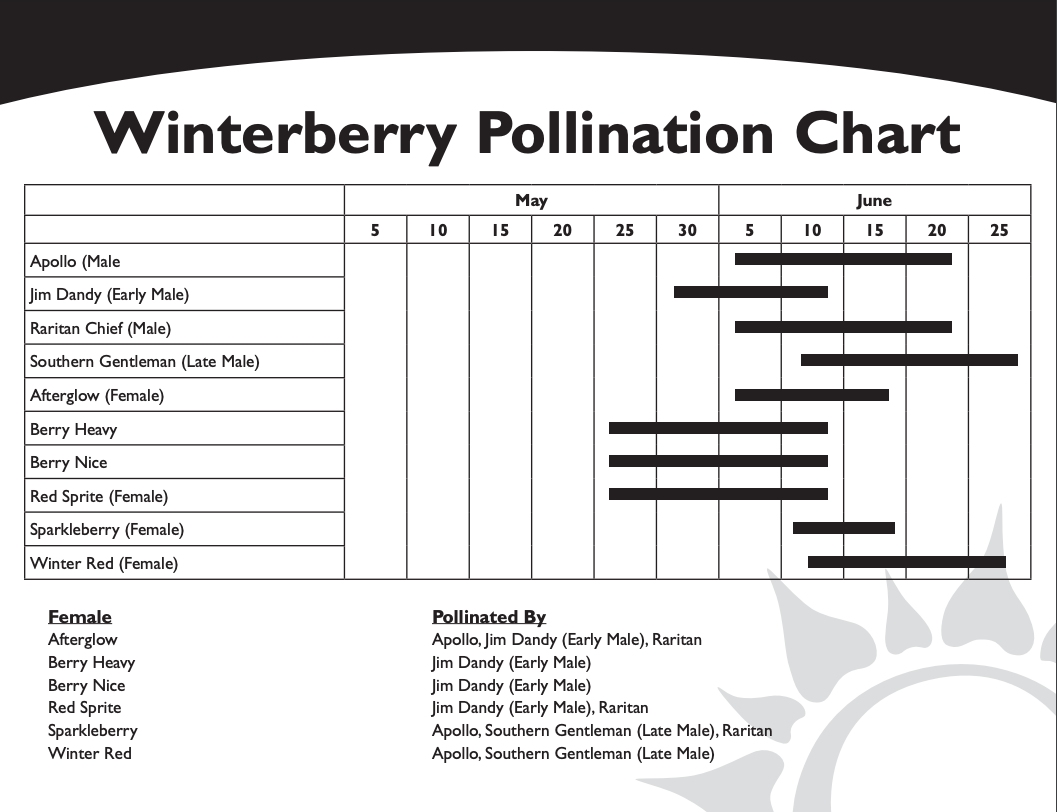
- Some shrub species, such as the native hollies (Winterberry and Inkberry), have named male and female cultivars. It is important to be sure that they are in bloom at the same time.
- Consult a helpful Winterberry Pollination Chart to match the bloom times for male and female cultivars.
Assure better fruiting for viburnums
- Our native viburnums (Arrowwood, Mapleleaf, Possum-haw, and Black Haw) are monoecious. Although all reproductive parts are contained within the flowers on a single plant, these species fruit best with cross-pollination between genetic variants.
- Gardeners can achieve this variation by buying multiple plants from a nursery that grows viburnum shrubs from seed rather than by cloning or by purchasing straight species shrubs from different growers.
- Another option is to buy a species and a cultivar with same bloom time.


Purchase new plants
- When purchasing native plants, it is critical to buy from reputable sellers whose plants are not treated with neonicotinoids. These systemic chemicals will render a plant’s nectar, pollen, foliage, seeds, and fruit toxic to wildlife.
- Native-only sellers will be especially knowledgeable about native species and provide helpful advice abut their use and care. See this list of sellers for Northern Virginia and local spring 2024 sales.
- It can be very helpful to know the two-part scientific name of a plant to be sure you are buying the exact plant you want. One plant may go by several common names, or several plants may share the same common name.


Plugs
- Plug plants, seedlings grown in separate cells, can be more economical than container plants for planting large areas. They are generally planted in 12” centers.
- Plugs are also preferred when planting around tree roots to reduce the size of planting holes.
- The roots of plugs are relatively undisturbed during planting, and although they may take a bit longer to develop top growth, they will establish strong root systems.
- Plugs may be harder to find than container plants, but they are available from mail order companies in bulk and some native plant sellers are beginning to carry them.


via Sunset Magazine

Containers

Photo Better Homes & Gardens
- Container plants are often preferred for immediate gratification in planting. These range in size from quart to gallon and even larger for shrubs and trees.
- Container plants are generally planted 15 to 36 inches apart on center, depending on the eventual mature size.
- Before planting, it is important to tease apart any circling roots.

- One negative aspect to buying plants in container is that plastic pots are hard to recycle. Look into recycling programs offered by some nurseries and larger retailers.