


Note: Click on images to see enlarged photos, captions, and photo attributions.
On a mobile phone, click on the information symbol (circle with a letter ℹ︎ symbol).

Learn more about other Mid-Atlantic plants:
Tried and True Native Plant Fact Sheets
Tried and True Native Plant Selections
for the Mid-Atlantic
Print Version (Legal Size):
Opuntia humifusa (Eastern Prickly-pear)
Since 2017, research has supported recognition of eight species in the wide-ranging Opuntia humifusa complex. Eastern Prickly-pear, one of three* native to Virginia, is widespread throughout the state but common in only some localities. It is found in Fairfax County. It produces showy, pure yellow flowers and, like many of its desert relatives, it is edible, but handle with care!
*Besides Opuntia humifusa, the Digital Atlas of the Virginia Flora lists Opuntia caespitosa and Opuntia mesacantha as native to the state.

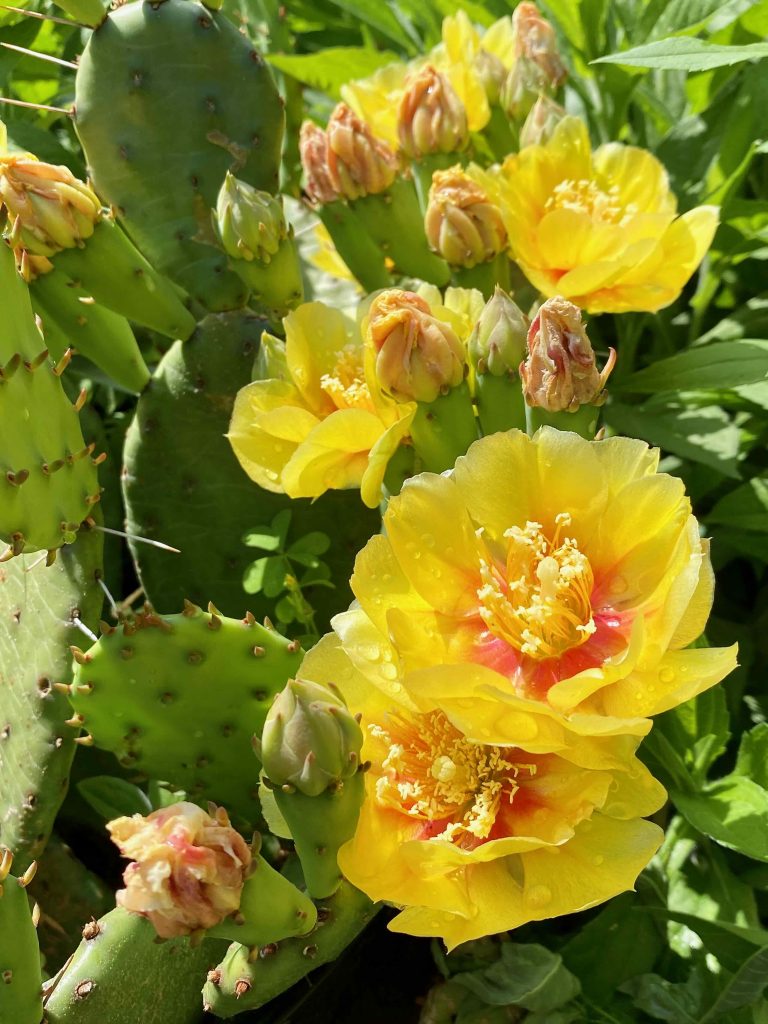
Opuntia mesacantha (left) and Opuntia caespitosa (right).
Though these two species are sometimes sold in nurseries and identified online as Opuntia humifusa, there are characteristics that distinguish them. Both O. humifusa and O. mesacantha share entirely yellow flowers and glochids but Eastern Prickly-pear lacks spines while O. mesacantha possesses some spines measuring up to one inch in length. O. cespitosa also has long spines and glochids (a dark reddish color), but its yellow flowers are red-tinged at the base.
Noting that further assessment is needed in Virginia, the Digital Atlas says O. mesacantha is “probably locally frequent in the c. and s. Coastal Plain, infrequent in the Piedmont” although it occurs in Prince William County. O. cespitosa is rarer in the state, indigneous only in Virginia’s Ridge and Valley region. It has been introduced, however, to the City of Alexandria where it was found on a limestone railroad ballast.