


Climate-Conscious Gardening
Join Master Gardeners in the Arlington/Alexandria unit of Virginia Cooperative Extension in a series of monthly articles updated from their original posting in 2021 as we explore the topic of climate change and practical actions individuals can take in their home landscapes in response.

By Elaine Mills, Extension Master Gardener
In preceding posts in this series, we have considered gardening approaches that can reduce homeowners’ carbon footprints and presented adaptive techniques to assist in dealing with the challenges posed by climate change. Another area of concern is making informed choices about the plants we choose for our gardens.
Avoiding, Removing, and Replacing Invasive Plants
According to David J. Ellis, editor of The American Gardener, research shows that invasive plants are among those species that benefit from current climate conditions with higher carbon dioxide in the atmosphere. These are defined by two presidential executive orders (2019 and 2016) as non-native species introduced into an ecosystem that can cause harm to the environment, economy, or human, animal, or plant health. Examples include vines such as English ivy and Japanese honeysuckle; ground covers such as periwinkle, liriope, and Japanese Pachysandra; trees such as mimosa and Callery pear; and shrubs such as nandina, barberry, and burning bush.
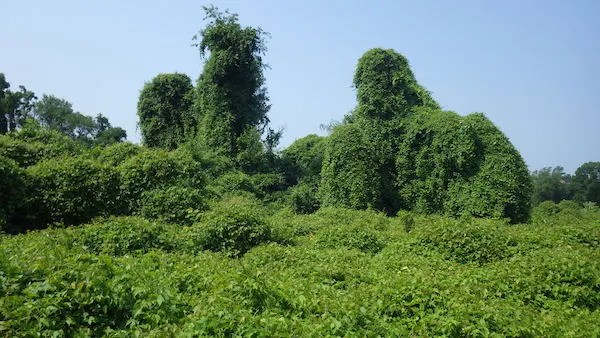
Unfortunately, these popular plants, which are still widely available at local nurseries and online, are not as benign as they may appear. Because of their wind-borne seeds and berries carried by birds, they can spread beyond cultivated plantings in home gardens to streams, fields, and forests where their rampant growth habits threaten natural plant communities. Their ability to adapt rapidly to new environments means that control of invasive species will be an increasing concern in the future.
Gardeners can avoid purchasing plants designated as invasive by referring to lists prepared by Arlington County and the City of Alexandria. On the MGNV website, fact sheets on over 45 of these plants list problems associated with each plant and suggest alternative native species that have similar ornamental characteristics. Accompanying short videos show the native plants in garden settings and describe techniques for removing the invasive species. Three recorded public education presentations in our Master Gardener Virtual Classroom, “Invasive Plants & Native Alternatives,” “Native Alternatives to Overused Foundation Plants,” and “Invasives in Your Garden” offer additional information.
Advantages of Using Native Plants
There are many reasons for gardeners to consider using native plants in their home landscapes. First, these species have adapted to our local soil types. Many of them have deep root systems that can help them weather extended periods of drought. They also grow without the need for chemical fertilizers and pesticides. Secondly, they have many ornamental characteristics, including colorful flowers, interesting seed heads and fruits, bright fall foliage, and distinctive bark.

Photo © Elaine Mills

Photo © Elaine Mills

Photo © Elaine Mills

Photo © Mary Free

Photo © Elaine Mills

Most importantly, native plants have evolved with our local wildlife, providing nectar and pollen to pollinators, feeding the caterpillar stage of Lepidoptera, supplying seeds and fruit to birds, and offering cover and nesting sites to a variety of wildlife. The close relationship with fauna is especially critical at this time when populations of insects and birds are in steep decline.
A 2017 joint study conducted in the DC area by Desirée Narango and Dr. Doug Tallamy of the University of Delaware, and Dr. Peter Marra of the Smithsonian Migratory Bird Center determined that home landscapes with a biomass of 70% native plants can provide proper nourishment for the larval stage of our local butterflies and moths. These caterpillars, in turn, can serve as food for the large percentage of birds which feed them to their young. A large native tree, several native shrubs, a number of native perennials, and a native ground cover used as “green mulch” can contribute to this ideal biomass, allowing room in the garden for 30% of a gardener’s favorite non-native (and non-invasive) plant species.
Resources on Native Plants
Master Gardeners of Northern Virginia offer multiple resources to help homeowners learn more about native plant species.
- We maintain nine demonstration gardens in Arlington and Alexandria with many labeled plants that can serve as inspiration for homeowners in the region.
- Our website has a large archive of recorded classes on sustainable landscaping with presentations on plant selection, categories of plants from trees to ground covers, and techniques for supporting birds and pollinators.
- Fact sheets on the Tried and True Native Plant Selections for the Mid-Atlantic provide detailed information on characteristics and care for a broad variety of plants that thrive in our region. These will help in placing plants in locations that provide the proper sun exposure and soil moisture.
- Best Bets fact sheets highlight native plants growing conditions, such as for wet or dry soil and sun or shade. Others focus on plants for deer and salt resistance, tolerance to Black Walnut, fragrance, erosion control, or attracting pollinators.
- Posts on our social media (Facebook and Instagram) regularly feature information on native plants and sustainable gardening practices. Of particular interest are our current series on “Celebrating Native Ground Covers” and “Landscape for Wildlife.”
Two additional websites provide assistance in selecting appropriate plants for supporting wildlife.
- The National Wildlife Federation’s Native Plant Finder, based on the research of Dr. Doug Tallamy, allows gardeners to search by zip code to find plants that host the highest number of butterflies and moths.
- The Audubon Society’s Native Plants Database also uses zip codes to create personalized lists of the best native plants for birds.

It is important to purchase native plants from reputable nurseries that don’t make use of systemic neonicotinoids that are toxic to pollinators. At big box retailers, for example, even plants labeled as “bee-friendly” may contain harmful residues of these chemicals. Consult the lists of native-only sellers and periodic native plant sales on the website of the Plant NOVA Natives campaign for more details. This website has a wealth of other helpful information on species native to the Northern Virginia region.
Homeowners seeking help in identifying plants on their properties can request a consultation with a volunteer ambassador of the Northern Virginia Bird Alliance’s Wildlife Sanctuary Program. Ambassadors can ID invasive plants, recommend alternative native plants, and describe sustainable practices to support birds and other wildlife.
References
- “Biodiversity for the Birds.” October 22, 2018. University of Delaware.
- “Gardening and Climate Change.” May 29,2014. Kojo Nnamdi Show, with Holly Shimizu and David Ellis.
- “How invasive plants could take advantage of climate change.” July 6,2021. Yale Climate Connections.
- Narango, Desiree, Douglas W. Tallamy, and Peter Marra. “Native plants improve breeding and foraging habitat for an insectivorous bird.” Biological Conservation, 2017.
- Presidential Executive Order 13112 – Invasive Species (February 1999)
- Presidential Executive Order 13751 – Safeguarding the Nation from the Impacts of Invasive Species (December 2016)