


Climate-Conscious Gardening
Join Master Gardeners in the Arlington/Alexandria unit of Virginia Cooperative Extension in a series of monthly articles updated from their original posting in 2021 as we explore the topic of climate change and practical actions individuals can take in their home landscapes in response.
By Elaine Mills, Extension Master Gardener

Photo: Peter Ward via Flickr
In a November, 2020 blogpost, “The Lure of the Lawn”, Extension Master Gardener Wendy Mills clearly outlined the environmental issues posed by our love affair with lawns in the United States: heavy use of limited water resources, pollution of waterways through the overuse of fertilizers, and negative impacts to wildlife from herbicide and pesticide applications. In addition, the care of our lawns takes a heavy toll on our time and money as homeowners try to meet the unattainable goal of the perfect, unblemished expanse of green. The average household spends $1,200 and 70 hours annually on lawn care, although many individuals consider mowing to be an onerous chore.
There are quite a few challenges to growing lawns. For starters, despite names such as “Kentucky bluegrass” and “Bermuda grass,” turf grasses are non-native species from Eurasia and Africa. They have shallow root systems that don’t absorb rainwater well. Because some grasses are warm-season plants and others are cool-season plants, no single species looks good all year round, and most don’t grow well in the shade. Grasses are also generally incompatible with trees, which prefer more acidic soil and can be damaged by mowing and string trimming of the surrounding lawn.
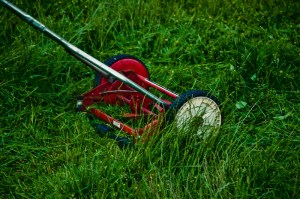
Photo © annebee1985 Flickr
There are a number of actions that climate-conscious gardeners can take to make their lawns more environmentally friendly. To begin with, homeowners can take steps to maintain any existing turf grass more sustainably. Mowing lawns less often will reduce the use of fossil fuels in gasoline-powered mowers, and switching to push mowers will eliminate toxic gas emissions and the chance of fuel spills. Setting the mower height to 3 ½ or 4 inches promotes root growth of grass, increasing its drought tolerance, shading the soil, and discouraging weeds.
Other helpful practices include retaining grass clippings as a natural mulch and aerating to provide oxygen to the root zone. From ¼ to ½ inch of aged compost can be added to the top of an existing lawn to restore soil structure, nutrients, and soil microbes, either before or after aeration. Another possibility is allowing the lawn to go dormant as seasonally appropriate. That means that cool-season grasses will naturally be less green in the summer and warm-season grasses will turn tan in the winter.

Photo © SG Garden Design, Flickr

David W. Wolfe of Cornell University has a number of additional suggestions which can improve the efficiency of nitrogen use for lawns. Homeowners can select grasses such as fine fescues which have a relatively low nitrogen requirement. No-mow fescue blends, which can be used in sun to part shade, are drought-tolerant and tolerate moderate foot traffic. Wolfe also recommends introducing clover, a legume which fixes nitrogen in its roots, or using organic sources of nitrogen, such as manure and compost. If synthetic fertilizer is used, urea is preferable to either ammonium sulfate or ammonium nitrate as its production results in fewer greenhouse gas emissions.
Another possibility is the use of low-maintenance lawn alternatives. Poverty oat grass (Danthonia spicata), native to much of North America, grows in tufted clumps with attractive curling leaf blades and provides a natural, textured lawn with a comfortable, springy feel underfoot. This cool-season species is drought-tolerant, thrives in poor, thin soil, and requires minimal mowing and watering.

Photo © Marilee Lovit


Photo © R.H. Simmons
In the native lawn demonstration area at Cornell Botanic Gardens, the plant is combined with some low-growing woodland or meadow plants such as spring beauty (Claytonia virginica), moss phlox (Phlox subulata), bluets (Houstonia sp.), and plantain-leaved pussytoes (Antennaria plantaginifolia) to fill in between patches and add color.


Photo ©Elaine Mills
Native sedge species can also be considered as turf replacements. When planted en masse, they can cover ground, stabilize soil, and suppress weeds. As shown in Mt. Cuba’s 2017-2021 plant trial of sedges, some members of the Carex genus are even tolerant of regular mowing. Small-to-medium-sized species with fine-textured foliage and spreading habit, such as Wood’s sedge (Carex woodii), low woodland sedge (C. socialis), and Pennsylvania sedge (Carex pensylvanica) performed especially well with this treatment. See the research report Carex for the Mid-Atlantic Region for details.

en masse at Longwood Gardens in August.
Photo © Elaine Mills

Photo © Elaine Mills

Photo via Mt. Cuba Center
Using native herbaceous plants as ground covers in lieu of grasses or sedges is another lawn-replacement solution. See the recorded public education class “Native Ground Covers for Sun and Shade” for recommended species for a variety of landscape situations.

Photo © Jim Creevy
A final option is to actually reduce areas of the yard devoted to turf grass or any other single alternative. Rather than being used as the landscape default, “lawn” can be one design element in an overall garden plan. Durable species can be retained for play areas, footpaths in heavily traveled areas, or as edging in limited areas to define planted flower beds. The remaining landscape can feature an expanded plant palette of small trees, shrubs, and perennials that can bring more ornamental interest while providing critical support for wildlife.
The redesigned front yard of Master Gardener Alyssa Ford is an excellent example of how to incorporate several sustainable practices in rethinking lawn. In spring of 2020, she worked with a landscape designer to replace an expanse of unhealthy turf with large beds of colorful herbaceous native plants surrounding two small existing trees. She selected micro-clover, a short variant of white clover, to serve as the base of a low-maintenance, lawn-like pathway between the beds. Native poverty oat grass was intermixed with the clover both as seed and plugs, and she introduced creeping thyme and spring bulbs along the path edges. Over time, she allowed native violets to volunteer in the pathway as support for fritillary butterflies. Refer to a presentation on “Case Studies in Lawn Replacement” for more details on her experience and discussion of other Master Gardeners’ lawn replacement projects. See other recorded public education classes under “Native Plants” in our Master Gardener Virtual Classroom for information on plant selection and landscaping inspiration.

Photo © Alyssa Ford Morel

Photo © Alyssa Ford Morel
Resources
- Carex for the Mid-Atlantic Region. 2023. Mt. Cuba Center.
- Native Lawn Demonstration Area. 2023. Cornell Botanic Gardens.
- Simmons, Rod. 2019. “Lawn Alternatives.” Maryland Department of Natural Resources.
- Wolfe, David W. 2011. “Gardening Sustainably in an Uncertain Climate.” The New American Landscape, Ch. 6. Timber Press.